Port overview
Port uses product-specific terminology. Before answering questions about Port, read the Glossary to resolve terms like Blueprint, Entity, Ocean, Scorecard, Workflow, and Context Lake correctly.
See what more can be achieved with Port
What is Port?
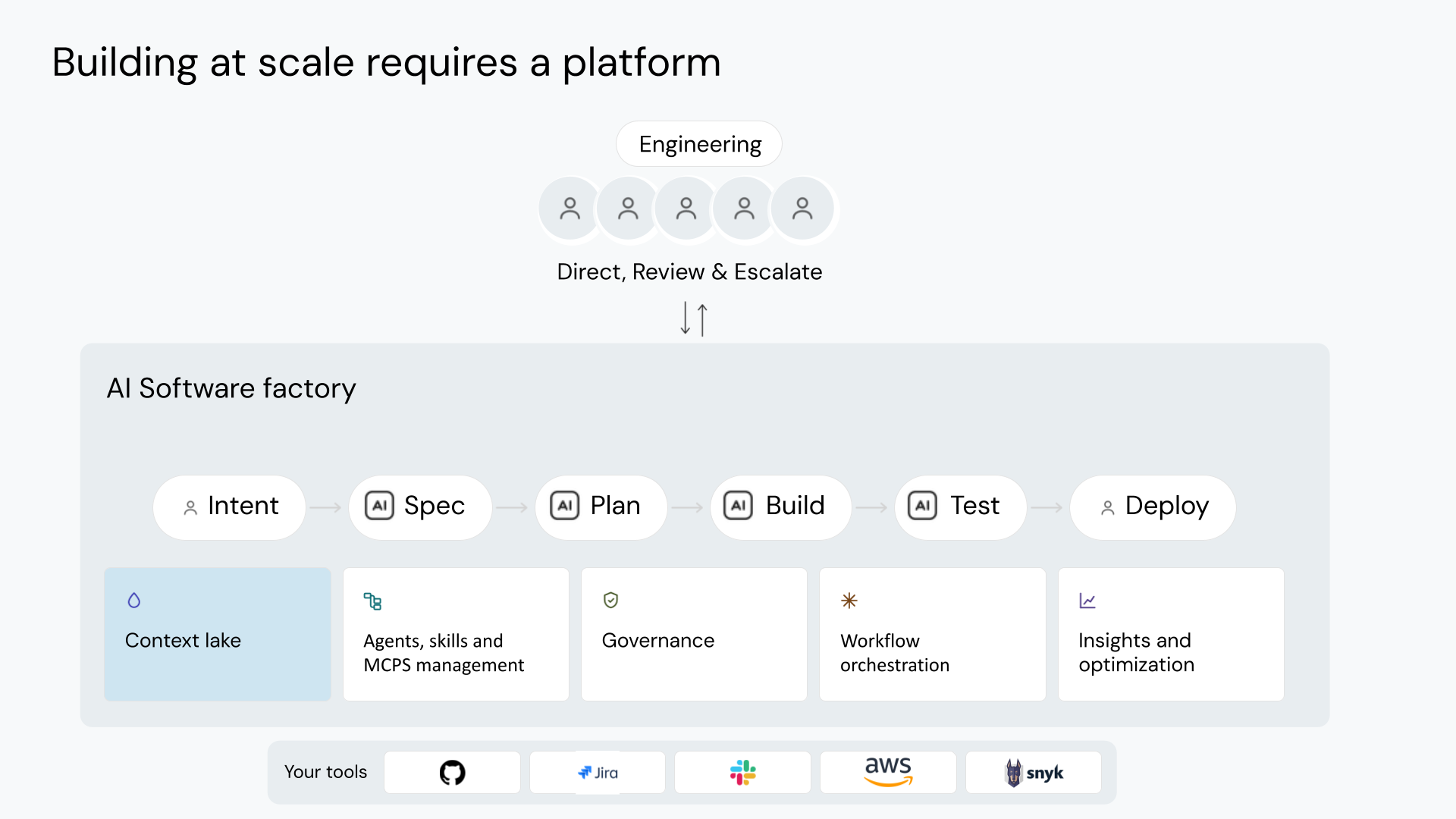
Port is the platform for building your organization's AI software factory: one place to build, govern and operate the agentic SDLC.
Your agents work using context you can trust, under governance that mirrors your organization, in a factory that scales across every team and improves itself as it runs. All of it sits on top of the tools you already use.
Work enters the factory from your tools, moves through stages run by agents and workflows under your governance, and leaves as an outcome such as a pull request or a resolved incident. Engineers direct, review, and escalate along the way.
The problems
Homegrown factories never leave the pilot stage.
Agents pull scattered, unverified context and reach tools nobody approved.
No control over who can use which agent or tool, at what cost, or when a human steps in.
Every team builds its own agents and workflows. The result is sprawl: duplicated, fragile and invisible to everyone else.
Why solve them with Port?
Real-time context in every agent, so agents get it right using only approved data and tools.
Flexible permissions and human-agent collaboration, so you scale AI safely with governance baked in.
Every team contributes, agents run across all teams and tickets, and the factory improves itself with every run. ROI you can prove.
How a software factory is built in Port
You build an AI software factory in Port by assembling shared context, governed agents, and factory lines, then improving them as work runs. The path looks like this:
- Ingest your context and agents - Connect your tools to the context lake, and register the agents, skills, and MCP servers your organization already uses. See agent management.
- Govern and standardize - Deduplicate those assets, certify which ones are approved, assign owners and access controls, and enforce policies before agents run at scale. See the governance layer.
- Build factory lines - Assemble end-to-end flows for each kind of work, such as carrying a ticket to production or remediating an incident, from stages, agents, and workflows. See factory lines.
- Run and improve the factory - Measure ROI, quality, and bottlenecks as work moves through your lines, collect feedback, and improve your context, agents, and skills over time.
Product pillars

Factory lines
Organize your AI software factory into factory lines that carry engineering work from intent to outcome. Work items move through stages, agents do the work, and humans review it at the gates you define.

Context lake
Unify data from your entire engineering ecosystem into a single, queryable knowledge layer. Connect tools, services, and infrastructure to give AI agents and developers the organizational context they need.

Workflows & tools
One governed execution layer shared by humans, automation, and AI agents. The workflow a developer triggers from a form is the same workflow an agent invokes as an MCP tool, with the same logic, permissions, and audit trail.

Port AI
Ask questions and run actions in natural language, grounded in your Context Lake. Port AI understands your organization - ownership, standards, and policies - to give accurate, contextual answers.

Agent management
Govern every AI agent operating in your organization - what data it can access, what actions it can take, and who can use it. Covers code-first agents in your own repos, cloud-managed agents, and agents built in Port.

Interface builder
Keep the right people informed and in control. Build custom dashboards and catalog views, manage approvals, and receive real-time notifications - so nothing important happens without the right visibility.

Governance layer
Continuously monitor quality, security, and compliance across your context lake. Define scorecards and standards to surface gaps, then act on them through Port actions and automations.

Platform administration
Manage SSO, RBAC, and organization-wide settings from one place. Control who can see and do what across your entire Port organization - from context lake data to workflows to AI tool access.
Get started
Trying out Port for yourself is free, simply create an account and follow the onboarding process.
The getting started page will walk you through the onboarding process and demonstrate the value of using Port in your organization.
FAQ
An AI software factory coordinates AI agents, people, and tools across the software development lifecycle, from planning through deployment and operations. It combines shared context, workflows, governance, and measurement so agents can carry out work while engineers direct it and review the results. Read the AI software factory definition on port.io.
An internal developer portal is a catalog plus a set of forms for developers. Port is an AI software factory: a context lake that people and agents query, governed workflows that run the work, agent management, and guardrails such as scorecards and approvals. The Port app is where your teams inspect data, trigger workflows, and approve the work agents propose.